Saturday, January 4, 2014

My Writing Year.


My Writing. 


I added 45880 words to my novel.
I wrote 8 articles for Divine, of which 7 were published.
Blog posts: 50
Number of days I wrote on: 365
I also enjoyed three days of the Melbourne Writers Festival.

My Novel Writing.


I started the year thinking I had a couple of chapters to write to finish my novel. Yeah right. About 24 chapters later, I am finally sure I am writing the last chapter. In a way, I am glad it has taken so long to get to the end as I was having problems working out how to bring it thematically to a conclusion. I always knew how the novel would end plot wise, but it took me until chapter 105 to figure out how to complete the theme or concept of the novel. The manuscript currently has 213,558 words.


 My Reading Year.


I seemed to be always too tired to read at night, so I should be happy that I actually managed to read 11 books. But I ain’t.

Why Do I Write?


A post on Google asked the question: Why do you write? They wanted an answer in one sentence.  With a less than impressive year of writing and reading, I asked myself that question. Here’s why I write:

I write stories I would like to read about the challenges I expect people will face in the future.

There you go. How about you?
  

Writing Aims For 2014


Once I write the last 1000 words of my novel, this year is going to be one of redrafting and editing. I have the second drafts of two novel manuscripts and one novella to keep me busy. I also want to get back into critiquing, including critiquing a few novels. 

And, most importantly, I finished the year with a Klout of 50.

Sunday, December 29, 2013

2013's Science-Fiction Books, Movies and Television.


Books


Once again, I did not read many books this year, but the ones I read were nearly all very good science-fiction. As two books were from the same series, you would expect one of them to be my favourite book, and it was: Wool by Hugh Howey. This is the first time a self-published ebook has been my favourite book of the year.

I also read Wools’ prequel, Shift, published by Random House. As I noted in my review of Shift, I thought it better written than Wool. I wonder if this is due to the input of an editor at Random House or just Hugh Howey becoming a better writer, or a combination of both. Wool and Shift are both a series of novellas set in a huge underground silo. Wool is the better due to its introducing the claustrophobic and paranoid world of the silo, and its stories are slightly more interesting than Shifts. I loved the tension and flawed characters in both books.

The equally brilliant The Twelve, by Justin Cronin, is thus relegated to the third best book I read this year. The Twelve is a sequel to The Passage. It is about a group of survivors in a future US, where genetically engineered vampire like monsters have wiped out most of humanity.  

Movies


I purposely avoided some science-fiction movies this year like Pacific Rim. I am sick of comic book good versus evil movies. I want to see science-fiction that explores themes and challenges my brain. So I am disappointed that Europa Report hasn’t had a theatrical release in Australia and won’t be released on DVD here until April 2014.

I was disappointed with Elysium. It started with promise, commenting on refugees and the growing gap between the mega-rich and the rest of us, but then the movie turned into a good versus bad action movie. I had hoped for more from its director Neill Blomkamp, especially after his magnificent District 9.

I enjoyed the spectacle of Gravity, but it really was just a story of human survival. And Star Trek Into Darkness was just another quickly forgotten good versus bad action movie.

My favourite science-fiction movie this year was Oblivion. It is set in the near future after the Earth has been attacked by aliens and humanity nearly wiped out. Those who survived abandoned earth and live in orbit around it. But they need more water before they can travel to another planet, so a pair of technicians is left on earth to maintain pumps that are extracting the water.   

(Warning spoilers) Tom Cruise haters really don’t want to see this one, as more than one Tom Cruise appears on the screen at once many times during the film. The film explores what would happen if a clone could remember the past of its original. The plot is complex and has a few twists too. It is a very good science-fiction thriller that demands thought on the part of the viewer.

Television/DVD’s


Due to multiple viewing platforms it is getting hard to review television series in a way that is relevant to other readers of this blog. It is no longer the case that everyone in Australia or the US has access to the same shows, as they can now watch series on apps, cable and websites as well as DVD’s and commercial television. What I had access to and watched is drastically different from what other science fiction fans watched.

This year I watched the following science fiction:

·         Eureka (series 4)
·         Stargate Universe (series 2)
·         Doctor Who (series 7 part 2)
·         Misfits (series 2)
·         Warehouse 13 (series 4)
·         Revolution (series 1 and part of series 2)
·         Continuum (series 1 and part of series 2)
·         Falling Skies (series 2)
·         Under the Dome
·         Utopia
·         Defiance (the first 3 episodes).

There really is a dearth of serious science-fiction series being made at the moment, so I was not a happy to see Stargate Universe end the way it did. I did not think much of the watered down Under the Dome. They should have turned it into a mini-series that more closely followed the book, instead of trying to stretch it out.

Due to it only recently being screened on television in Australia, I have not watched this year’s season of Fringe, which going on past seasons might have been my favourite science-fiction show of the year.

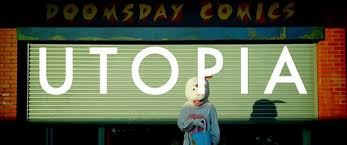
I recently discovered Utopia on SBS On Demand (only for the next three days). A six-part English series that is as violent as anything made by Quentin Tarantino. It is set in the near future where a group of fans of a comic book called Utopia, get their hands on notes and drawings for its sequel. They are unaware that those notes and drawings contain the answer to a conspiracy that is set to devastate the world, and they are pursued by spy agencies and merciless killers. It is consistently tense, full of stunning visuals and has a really groovy soundtrack. It is my favourite science fiction show of this year, just edging out Misfits.

Misfits is also set in Britain and is about a group of young wrong-doers who are doing community service and, after a meteor shower, end up with super powers that reflect their personalities. Unlike an American version, they don’t have ambitions to go out and save the world or become super-criminals. They keep their abilities secret and only use them by accident or when forced too. It is more a comedy drama, and I very much appreciate its originality and unpredictability.  

And finally, the best 50th anniversary episode I saw this year was Doctor Who’s The Day of the Doctor.  

Saturday, December 21, 2013

Shift: A Review of Hugh Howey's Apocalyptic Novel


Shift is great apocalyptic science-fiction. It is a prequel to the also excellent Wool. I reviewed Wool earlier this year. To fully appreciate Shift, you need to first read Wool. Anyone who reads Shift without first reading Wool risks missing out on the fun of discovering answers in Shift to questions posed in Wool. Perhaps this is why Shift received only a lukewarm response when reviewed as a standalone book on the Book Club.

Wool was originally written as a collection of novellas telling three distinct stories, all set in an underground silo. The silo is huge, with over 130 levels and thousands of people living in it. Inside the silo are farms, schools, power generators and manufacturing plants.

The silo’s are very low-tech. Access to computers is limited to a core group of information specialists who are all located on one level of the silo. The general population has no access to phones or other communication devices. There are no television or radio broadcasts, there is not even a printed newsletter. So communication is by word of mouth and notes written on scarce paper.

The silo does not even have a lift, just a large central stairwell. It can take three days to travel from top to bottom. This low-tech approach makes it much easier to control the population. There will be no twitter revolutions in a silo.    

The general population of the silo think they are the only people alive on the planet. Cameras show them the wasteland outside. Every now and then, a “criminal” is exiled to the wastelands, where their protective suits are quickly eaten away by the toxic air. They die within sight of the cameras for all in the silo to see. So the inhabitants of the silo know it is not safe to leave, that their lives depend on the silo continuing to function.

Shift is also a collection of three stories. The first story is set before the stories in Wool begin. The third is set in the same time-frame as one of the stories in Wool and the second is set in between the stories in Wool.

The first story tells of the construction of the silo. We find out who built it and why. The story follows newly elected US Senator Donald Keene. He is asked to design levels for a top secret underground shelter by a senior senator and family friend. He has no idea what the shelter is to be used for, but he is eager to please the elder statesman so he agrees.

At the same time we are told the story of Troy, who after fifty years in cryostasis, begins his first shift in the silo. He is its overall manager. His job is to ensure that the silo continues to function according to processes set out in a thick manual. Troy gradually starts to believe he is not the person he thinks he is. 

The second story, or shift, is set many years after the first. A silo manager is woken to help stop a revolt. This story is told from the silo manager’s point of view and from that of a porter caught up in the revolt. Porters carrying supplies, equipment, notes and rumours between the many levels of the silo. 
      
The third shift or story takes place decades later. A silo manager discovers what the future holds for him and the thousands living in his silo, and he does not want to be a party to the end result. Concurrently, the story of Jimmy and how he came to be one of the few survivors of a revolt unfolds. Jimmy was an intriguing character who appeared in the last story in Wool.

Shift reads better than Wool. I found myself admiring passages in Shift. Unlike in the middle story in Wool, the tension never sags in Shift.  The version of Wool I read was self-published, whereas Shift was published by Random House. So the improved writing could be due to the publishing house’s editing, or Hugh Howey might just have improved as a writer. He didn’t have to improve for readers to enjoy the tension and twists he creates from flawed characters living in a claustrophobic and rigid society.

One of the signs of a good writer is being able to get a reader to empathise with a bad guy. After reading Wool, I wanted to hate the bastards that created the silo. Senator Donald Keane was one of those bastards. At the beginning of Shift, he only cared about making himself look good in the eyes of the older senator, and he took drugs to suppress his concerns about what the shelter might be used for. Troy was also a bad guy, he used a manual to supress the people. But the author, Hugh Howey, gives both characters a narrative that is easy to sympathise with.  

I thoroughly recommend Shift, but please read Wool first.