Sunday, June 21, 2015

A Review of Steve Amsterdam's What the Family Needed


 I enjoyed Steve Amsterdam’s award winning apocalyptic, climate change novel Things We Didn’t See Coming, so I was quick to purchase a copy of What the Family Needed. Calling Things We Didn’t See Coming a novel might be bit of a misnomer as it is a collection of short novellas. But they all feature the same character and are told in chronological order. Amsterdam uses the same technique with What the Family Needed, but this time each story is told from the viewpoint of a different character. 

What the Family Needed begins with teenagers Giordana and Ben arriving at their Aunty Natalie’s house with their mother Ruth. Once again their mother has deserted her husband. Giordana is looking forward to the normalcy of her Aunts family’s stable life, but she has not factored in the fantasies of their son Alek.

Gordiana feels her mother does not care about her opinion of her father, and that she is taken for granted by her mother. It’s like she is invisible. While being entertained by one of Alek’s made-up fantasy games he asks her to choose: invisibility or flight? She chooses invisibility. Minutes later she wishes she could sneak down stairs and listen to what her mum is saying about her dad, and she suddenly becomes invisible.

Ben, Ruth, Natalie, cousin Sasha, Uncle Peter, and Alek all tell stories of their own. The stories are in a chronological order so they don’t overlap or show an incident from a different viewpoint.

Ben’s story starts a few years after Giordana’s. He is unemployed and full of regret for marrying and having a baby too young.  He wants to be free.  Guess which super ability he gets.

Ruth is a nurse who wants to make the lives of her patients and families as comfortable as possible, if only they would tell her what they really wanted.

Sasha has never been able to form a long-term relationship. He would do anything to get his lover to return his love.

Natalie is busy, too busy to help and fix her delusional son Alek, if only she was more efficient.

Peter just wants his family to stay stable and for nothing to change.

They each acquire a super ability, but their abilities have mixed results.

The novel is written in a wry tone. Most readers will identify with the desires of the characters: wouldn’t it be nice to find out what people are saying when you are not around, or to flee a boring life, or if nothing ever changed.

The novel ends with Alek’s story. It is clear from the start of the novel that he is the catalyst for the gaining of super abilities by his relatives and other members of his family. I was very keen to find out how and why. Alek’s story offers surface answers but not the bottom of the iceberg answers I was looking for. I felt a bit dudded, disappointed. 

Things We Didn’t See Coming had a sense of urgency about it. It has a demand that we change, and a character that changes to suit the environment. While What the Family Needed shows that change can be hard to cope with, even when magic intervenes. In the end, it says be careful what you wish for because the change might not be worth it. It is a gentle novel, perhaps too gentle.

Sunday, May 31, 2015

My Writing Efforts in May

In May I started behaving more like a writer, even though I am still very tired. I wrote a lot more and I started critiquing again. I put this down to quitting Facebook six weeks ago. I really missed Facebook to begin with, but not so much anymore. I gave myself permission a few days ago to go back on Facebook, but I still haven’t ventured onto it, though I might to plug this blog post. I decided that I will only go on Facebook after I have written at least 500 words of fiction – or edited for 2-3 hours -- and done whatever critiquing activities I had scheduled for that day.

Novel Writing.


In May, I wrote 13,525 words of my novel Branded, more than doubling my monthly totals for this year. I reached my daily quota of 500 words on 18 days with 1020 words as my best daily total. So I averaged 436 words a day.

I have written approximately 87,000 words of the novel. I had hoped that the first draft would be around 90,000 words, but my characters decided not to cooperate with each other at the end of part four. Consequently, I have just started the fifth and final part of the novel. It should go for around another 10,000 words. So I should finish the first draft in June.

I am writing it as a stand-alone novel with some hanging threads left for the reader to imagine what might happens next. But those threads are starting to wrap my imagination in sequel ideas.

Critiquing.


I mentioned in my last post that I had joined critters.org and the Australian Writers Forum. In May I did a critique a week for critters, three short stories and the first chapter of a novel. One short story impressed with a non-traditional narrative style.  But the novel appeared to have a very overused plot driver.

So far nothing has appeared on the Australian Writers Forum for me to critique, so I will start searching for active Australian science fiction critiquing groups again.

Reading.


I finished reading the disappointing What the Family Needed, by Steven Amsterdam. It had none of the urgency or call to action of his excellent Things We Didn’t See Coming. I will review What the Family Needed in my next blog post. I am just about to start reading Amnesia, by Peter Carey. He’s one of my favourite authors, loved True History of the Kelly Gang, and Illywhacker was great fun too.


Friday, May 22, 2015

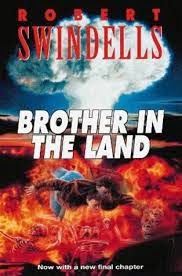
Review of Brother in the Land

Brother in The Land begins with teenager Danny taking a break from working in his father’s corner store for a long bike ride into the English countryside. It starts to rain, so he takes shelter in a World War II pillbox. As he waits for the rain to stop, he sees the flashes of nuclear missiles exploding.

Aware that the rain might contain radiation, he waits for it to stop and then rides back to his fictional hometown of Skipley. It is badly damaged, and hundreds are dead. The rest of the novel tells the story of Danny’s attempt to survive.

Brother in the Land is a young adult novel told exclusively from Danny’s point of view. Danny seems slightly emotionally detached from what is going on around him. He mourns little for family and friends who died, which leaves the reader wondering if he had had any friends. But perhaps he is just in shock and too busy getting on with surviving to mourn.

The novel does a realistic job of describing the aftermath of a nuclear attack: the breakdown in authority, the wait for help while people do whatever it takes to survive, people dying of radiation sickness, crops failing, and deformed babies being born.

The novel was written and set in the 1980s, at a time when nuclear war was a big fear. But it reads like it could have been written in the 1950s. One reason for this is the near-total absence of females in leadership roles. There is only one substantial female character in the novel, the tough but pretty Kim. She is used to show that Danny still has teenage hormones.

The novel has a real boy’s own adventure feel. Obviously, its author, Robert Swindells, had a military background, with Danny’s devotion to duty being one of the novel’s big themes. Duties included helping his family and joining a militia to fight those who sought to enslave the survivors.

The prose is straightforward, with little creative flair. The sentences are short, and there is a lot of foreshadowing. Brother in the Land won the “Other” award, but I could find no reference to that award on the web.

Originally, the novel ended with little hope for Danny’s survival, but Swindells added a new chapter that gives some hope. This seems unnecessary and goes against the novel’s overall bleakness. It also seems unrealistic.

Except for the additional chapter, Brother in the Land appears to be a relatively realistic portrayal of a teenager trying to survive after a nuclear war. As it progresses, it becomes a passable action novel, with Danny forced to fight to survive. But his lack of emotion left me thinking the author was too scared to explore the inner thoughts of his main character. It is a novel for teenage boys who don’t want to read any girly emotions.

Friday, May 8, 2015

My Writing (meltdown) in April.


Image result for free image train wreck

I had a writing meltdown in April. I was, and still am, frustrated with the lack of output and progress with my fiction writing. Strangely, the meltdown was caused by my non-fiction writing after I submitted an article to Divine in mid-April. The editor immediately replied, wanting a few changes. Most of the changes were due to restrictions imposed on Divine because it is run by the state government. These restrictions would not allow me to mention the name of the website the article was all about.

I had hoped that I would be on safe ground mentioning this website because its creator – who I interviewed – had, what I considered, a great deal of credibility due to her advocacy in the disability field. The website had also been written about in mainstream newspapers.

My initial reaction to the editor’s request for changes was that the article would not work without mentioning the website, so I should just scrap the idea. But then what would I write? I had no idea. Coming up with ideas for Divine is becoming harder and researching and writing them seems to becoming less enjoyable and fulfilling.

The last article that I had enjoyed writing for Divine was a review of the movie The Theory of Everything.  The unsentimental and unsensational movie combined with some knowledge of Hawking made it easy to write. But since then I have had various issues when researching and writing articles. I thought that with the problems my recent submissions were encountering, maybe I should just take a break. So I shot off an email to my editor saying I was going to scrap the article and take a break.

When I finally had a look at the article again, I found it relatively easy to remove the website name and make the necessary changes that came with that to still have a reasonable article. So I sent another email to my editor saying that I could make the changes if she still wanted the article. I had real doubts whether the editor actually wanted the article. I also had real doubts that it or anything I had written for Divine were any good. I feared my enthusiasm for Divine had more to do with my articles being published than my writing.

I then began questioning whether anything I had ever written was more than just misguided enthusiasm. And whether my Master of Creative Writing was more a Master of Creative Delusion. On top of that, I thought my writing had improved little over the years, and might even have gone backwards due to my constant tiredness.

Anyway, I decided to take a real break from writing and get away for a few days. I went to Melbourne for four nights.  I went to the footy, Scienceworks (including the planetarium), the zoo and the museum. I almost expelled writing from mind for four days except when I came across two ideas for articles for Divine.

But then came the day I was due to return home, and I checked my emails. My editor wanted to speak to me. She wanted to “renegotiate” how I wrote for Divine. This sounded ominous to me, like she was going to take the opportunity to get rid of a crap writer. Unfortunately/fortunately, she was not in the office that day, so I could not contact her to have my fears confirmed. Instead, I had all day, including a three-and-a-half hour train trip to ponder what renegotiate meant. As it turned out, I did a lot more than ponder Divine, I spent a lot of the train trip thinking about my writing goals and why I was still standing alone at full back, a long way from my goals.

I concluded that I was more in love with the idea of being a writer and trying to appear like one, rather than actually being one. I had written 46 articles of varying quality for Divine, and I had written a post for this blog nearly every week for the past seven years, and I had done a number of writing courses, and I had completed Nanowrimo three times, and I had connected to 100’s of writers through social media and some of the published ones actually commented on my posts. I even write every day, but precious little quality fiction.

I am still yet to have any fiction published. I have three novel scripts, a novella, and numerous short stories all filed away in first or second draft stage. Although I write every day, I don’t write much and on many days writing is the last thing I get around to doing. I don’t read much either. The way I am going, when I die the sum total of my fiction writing will be a dozen first/second draft novel manuscripts on a USB stick which no one else will ever read.

Something had to change. On the train trip home, I felt I had two choices, either get stuck into fiction writing or quit. By getting stuck in, I mean writing a lot more quality fiction, and improving as I learn more about the writing process. To help improve my writing I need to get it critiqued.

I need to make changes in my life to help me achieve my writing goals. The big one is to overcome my constant tiredness. I am sure one of my chronic illnesses has a lot to do with it, so it’s time to finally try everything to get it under control. To help with this I decided to reduce some of the stress in my life, part of which I achieved by negotiating a two-month break from Divine. I have no doubt that my reaction to the Divine editor’s changes and my diminished enthusiasm for writing for Divine have been influenced by my tiredness.

I decided to get off social media. There are a number of reasons for doing this, including using that time to write. But primarily I wanted to get rid of the delusional satisfaction that I am a real writer because I associate with actual writers, many of whom are published authors. In reality, I am just a wannabee writer. So I quit Facebook a fortnight ago. The lack of contact with people I care about, and many who I am curious about, has been very hard, and I really miss playing Word with Anny during my afternoon coffee break.

I decided to get some quid pro quo going for critiquing. I re-joined critters.org, and I also joined the Australian Writers’ Forum. I need to find other science fiction writers for mutual critiquing. My search for trusted critiquers and beta readers begins.

I also have decided to spend less time blogging. Some of the posts on this blog have taken many hours to research and write, time I could have spent writing or learning about writing. From now on most of my posts will be book reviews. I figure reviewing books will get me thinking about what works in writing.

So what did I actually achieve writing wise during the month? As I didn’t write for 14 days in a row, I only added 3766 words to the novel. I read a book, Robert Swindells’ nuclear apocalypse young adult novel Brother in the Land, review pending.

PS. I seem to be writing more fiction since I quit Facebook. And I also find myself thinking more about the novel I am writing and not about some status update on Facebook. But computer problems have not helped. First some malware, then a product recall on the power cord for my laptop, where they recommend not using it until a new cord arrives. Toshiba told me that they will “process” my registration for a new cord within five working days. Does that include mailing the thing out? As I was also having trouble with the laptop’s DVD burner I decided to buy a new computer. Now I have to get use to using Windows 8. In between fiddling with the new computer and transferring files and trying to remember all those passwords, I did make the time to critique a story for critters. Yaa, one whole critique this year.


Thursday, April 23, 2015

Hugo's sad puppies.


 Image result for hugo award
(I have made a few edits to this post - the original post was written when I was very tired and fed-up with the world and the whole debate is very messy.) There is a lot of controversy surrounding the Hugo awards this year. For those of you who don’t know, the Hugos are science fiction awards for best novel, best short story, best movie etc. Books and movies are nominated for the Hugo by people who either attend that year’s Worldcon, or who pay a non-attending membership fee. Basically it’s a popular vote, so the books and films nominated are probably not the best that came out that year, just popular with members of Worldcon.

Over recent years a few writers have decided they are upset with what they deem to be leftist science fiction that is winning the Hugos, so they decided to try and influence the awards by getting people to nominate a selection of science fiction that suited their views of what science fiction should be. I personally prefer science fiction that explores themes and ideas, rather than just space adventures and shoot-em up thrillers. I read last year's winner Ancillary Justice, and although it probably fitted into the militaristic sub-genre, it explored many ideas and themes.   

The upset writers include Theodore Beale (who writes under the name of Vox Day), Brad R.Torgersen and Larry Correia. They called their nominations the Sad Puppies and Rabid Puppies.

The Sad/Rabid Puppies


The Rabid Puppies (Theodore Beale) nominated the following books for the Hugo for best novel: 

Monster Hunter Nemesis, by Larry Correia, Baen Books 
The Chaplain’s War, by Brad Torgersen, Baen Books 
Skin Game, by Jim Butcher, RDC 
Lines of Departure, by Marko Kloos, self published 
The Dark Between the Stars, Kevin J. Anderson, Tor Books.

(Since writing this post Marko Kloos has withdrawn his book, and it has been replaced by The Three Body Problem, Cixin Liu, Ken Liu translator, Tor Books.)

The first two are written by the Rabid Puppies and Sad Puppies conveners. 

I had a look at Larry Correia’s site and his bio shows a picture of guy with a great big gun, and I stopped reading his bio after he had fought a gang, three of whom he injured and the only way they stopped him was with a gun. His books sound like boy’s own adventures – probably with a lot of gun play. Not my type of book.

The Sad Puppies (Brad R Torgersen) nominated the same books except Torgensen didn’t include his own book, instead he listed Trials by Fire, by Charles E. Gannon, Baen books. Interesting that no female authors made their lists. 

Larry Correia endorses Torgersen's list as the torch bearer for the Sad Puppies. 

The Hugo Award


The Hugo nominees for best novel were recently announced. 

Ancillary Sword, by Ann Leckie, Orbit 
The Goblin Emperor, Katherine Addison, Tor Books 
Skin Game, by John Butcher, RDC 
Lines of Departure, by Marko Kloos, self published 
The Dark Between the Stars, Kevin J. Anderson, Tor Books.

So three of the Sad/Rabid puppies books made the list. I find it amusing that both of the puppies conveners novels did not make the list and were replaced by two female nominees.

According to Larry Correria - "I just want to make a comment about why I’m personally not on the list. I was contacted by the administrators on 3/20/15 and informed that Monster Hunter Nemesis was a finalist for best novel. I emailed them back the same day and turned it down. Whoever was next in line was then moved up to be a finalist in my place. I refused the nomination for one simple reason. The Sad Puppies campaign isn’t about any one person. I felt that ultimately my presence would be a distraction from the overall mission."

The question remains, are the Skin Game, Lines of Departure, The Dark Between the Stars and Monster Hunter Nemesis worthy nominees? The nominees for the Nebula and Arthur C.Clarke awards, two other big awards for science fiction, might hold some clues.

The Nebula Award


The nominees for the Nebula award for the best science fiction or fantasy novel are: 

Ancillary Sword, by Ann Leckie, Orbit 
The Goblin Emperor, Katherine Addison, Tor Books 
Trials by Fire, by Charles E. Gannon, Baen books 
The Three-Body Problem, Cixin Liu, Tor 
Coming Home, Jack McDevitt, Ace 
Annihilation, Jeff VanderMeer, FSG Originals.

So one of the puppies made the Nebula list, Trials By Fire.

The Arthur C. Clarke Award


The Arthur C. Clarke Awards nominations for best science fiction award were: 

The Girl With All the Gifts, M.R. Carey, Orbit 
The Book of Strange New Things, Michel Faber. Canongate 
Europe In Autumn, Dave Hutchinson, Solaris 
Memory of Water, Emmi Itaranta, HarperVoyager 
The First Fifteen Lives of Harry August, Claire North, Orbit 
Station Eleven, Emily St John Mandel, Picador.

The Arthur C. Clarke nominees seem to inhabit a different book universe to the other two awards and the puppies.

The Goodreads People’s Choice


The Goodreads People’s Choice for favourite science fiction novel is not an award, just a popular vote on twenty books nominated on the basis of reviews they receive on Amazon. The only sad puppy in the Goodreads list was Lines of Departure, which came in at number 20. 

Lines of Departure also made the Hugos list. So it looks like the other two Sad/Rabib puppy nominees that made the the Hugo list might not be worthy of their positions on the ballad. And the Rabib puppies nominee of Trial of Fire, which did not make the Hugos list, but made the Nebula list, might have been a worthy nominee.

Worth noting is that Ancillary Sword, by Ann Leckie, and The Goblin Emperor by Katherine Addison have been nominated for both the Hugo and Nebula awards.

Overall, since finding out that the Hugos are based on a popular vote, I don’t place a great deal of value in them. As mentioned above, I did buy Ancillary Justice, but it won all three of the awards and was number 20 on the Goodreads poll in 2013. Ancillary Justice was very good, so I will probably buy the sequel. As for the rest, I have previously mentioned in a post about the Goodreads awards that The Fifteen Lives of Harry August sounds interesting.

Friday, April 3, 2015

My Writing Efforts in March.


Novel Writing.  


In March I added 5848 words to Branded, a science-fiction, young adult novel. So I improved on February’s 4841 words. I averaged 188 words per day in March compared to 173 words per day for February and 155 words per day in January.

The novel is now just under 70,000 words. It has five parts and I am probably just over halfway into the forth part. It looks like the novel will be about 100,000 words, the first draft at least.

I am still very much enjoying writing it. The dysfunctional group of characters are barely getting on at the moment, but one of the causes is about to be removed. 

Non-Fiction Writing. 


I wrote one article for Divine in March. It was about a lack of actors with disabilities playing characters with disabilities, especially in Australian movies and television. I contacted a few people in the industry for the article and about half of them got back to me. I learnt a lot about the issue from those who did, like Australian actress Kate Hood. She has the unique perspective of being an in demand actress before she developed a disability and she is involved in an Actor’s Equity disability committee.

A lot has been written about actors without disabilities “cripping up” to play characters with disabilities. My article is an attempt to provide some factual information from people and organisations directly involved in the industry like actors, casting agencies and unions (note the producers and directors did not get back to me).

The article, Actors with Disabilities, was put up on Divine last Thursday.

I also started research on my next article on disability parking. It is about people who don’t have disabilities who feel they are entitled to park in disability parking spots. 

Blog Writing. 


Four posts for the month. I missed a week while researching a post on ebook piracy, which I found it to be very common. Every author I checked had pirate versions of their ebooks available on the web. 

Reading.  


I read two books for the month and enjoyed them both. No Limits, by Australian/New Zealander Holly Childs, is a hip novella, full of hip people doing hip things while they worry about the world ending.  And The Method, by Juli Zeh, is a dystopian science-fiction thriller in the tradition of 1984 and Brave New World. 

Critiquing. 


I still have not critiqued anything this year.

So far this year I have written on every day.

Health permitting, I hope to greatly improve on my novel writing efforts and critique something, anything, in April.